Showing posts with label Element 3: Conservation and Management. Show all posts

Thursday, May 16, 2013

Guest Lecture: John Eadie

John Eadie of UC Davis came in to give us a talk about a pressing issue in the Central Valley. An area that we learned is critical for many waterfowl on the Pacific Flyway, approximately 4-6 million waterfowl winter there. During the winter time, the main need for waterfowl is food. So managers need to assess how much habitat is necessary in order to take care of the waterfowl and provide enough food. It is a simple calculation (maybe too simple)


Area needed = # of birds + energy/bird
                       ___________________
                         energy available/acre


This is a case of supply and demand; however, in the Central Valley the food has been running out to early and there is not enough supply to meet the demand. Assessments were done on various wetlands to see how good habitat was. There was a wide range of results, but John said all of the managers of the habitat believed their land was managed effectively to take care of the waterfowl. This was not the case as some habitat was really poor. This means we need to enhance habitat so that by chance we will not need to have so much habitat in the end, and raising awareness to managers about what good habitat is will in the end, create more supply for the waterfowl during their wintering times.
A recent study showed that the Central Valley Joint Venture establishment has been correlated with lipid reserves in some waterfowl, potentially due to the increase in land saved and the creation of optimal habitat.
Another study is being conducted currently to determine what the best way is to create optimal habitat for the waterfowl. The independent variables are the water given to the areas. This included the length of time a place was getting irrigated and how often. From this, a feasible way was found to irrigate the wetlands and just how often. Unfortunately, this method corresponded with an increase in mosquito numbers, which could be expensive to control (and it is regulated by law that it is controlled). This begs the question: how do we please everyone? Adaptive management strategies must be created for nearly everything, including how to best manage habitat for the waterfowl in the Central Valley. New methods must be implemented to find a balance between optimal waterfowl habitat, reduction in mosquitoes, public approval as well as something that is feasible. Being a manager seems a lot more difficult than I previously anticipated and many factors need to be taken into consideration. We will see what types of methods this study will present to manage for the waterfowl.

Sea Duck Research and Management

White-winged scoters diving in dive tank at the Delta Waterfowl Foundation, Manitoba, Canada
This is an important management issue because of the fact that sea ducks are so difficult to study. The group consists of 15 species in the tribe Mergini, including Eiders, Goldeneyes, Long-tailed Ducks and Harlequin Ducks and 11 out of these 15 species have been thought to have declining populations. The decline may be attributed to overharvest, lead poisoning  oil spills, fishing nets, loss of habitat and predation. It is difficult to help these sea ducks when there is such little information circulating about them. The USGS has begun experimenting with captive sea ducks to learn a little more about their life history. They are set up in large enclosures and are observed to see their techniques for feeding. However, more research still needs to be done. Since this group of waterfowl only accumulates to about 5% of the harvested waterfowl, they are typically not a high priority on conservation since little money is coming from them. The Sea Duck Joint Venture is trying to create partnerships in order to study and conserve these species. So far they are involved in about 129 different studies (and are no longer able to take on anymore). With these studies they are trying to learn how to best monitor the sea ducks and identify important areas in these ducks life such as breeding, molting, staging and wintering areas.

Case Study: Red-breasted Goose

Previously I talked about this in the Breeding Biology section of the blog; however, more needs to be discussed about the conservation issues the Red-breasted Goose (Branta ruficollis) faces. This waterfowl is one of the most endangered in the Eurasian continent. These geese breed with avian predators which will attack foxes that will potentially predate the nests of these geese. With the presence of the hawks, owls and falcons, the Red-breasted Goose is able to have a higher nesting success. There is a cost to this; however, at times, the adults will be eaten and once the goslings hatch, the Red-breasted Goose must ensure that the goslings make it to water safely before the raptors can hunt them. The population of these geese crashed in the 1950s, potentially due to an indirect effect of DDT. A common conservation case of the Peregrine Falcon (Falco peregrinus) and its steep decline due to the influence of DDT and its egg shell thinning effects, the Red-breasted Goose was also affected because the Peregrine Falcon were no longer able to protect the nests of the Red-breasted Goose. The geese sleep on ponds, but these ponds are often occupied by fisherman which cause disturbance for rest. Other threats include rodenticides, lack of hunter knowledge, man-made infrastructure deaths and land changes from cereal crops (preference) to vegetables and vineyards.
Suggestions for management include educating hunters, creating feeding grounds, higher management on fishing around the geese to reduce disturbance as well as to continue the ban on the poisons that killed many falcons.

Case Study: Canvasback

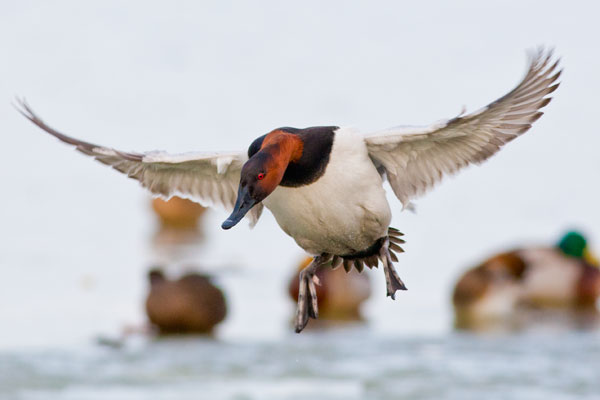
Historically, the Canvasback (Aythya valisinera) declined due to hunting, habitat degradation and poor water quality. On the east coast of North America, it was one of the most hunted birds and was claimed to be one of the tastiest. Currently, their populations are doing well with about 700,000 individuals from a census done in 2012. The reason that this bird could be recovering may be attributed to various reasons such as the ban of lead shots, the Wetlands Reserve Program, MBTA and Lacey Act. For the future, there are still issues that await the Canvasback management. For instance, there is still high wetland loss which means less habitat. These animals are diving ducks and rely on these wetlands more than some birds because they are diving ducks and the aquatic vegetation that the wetlands provide. There was a diet shift in the Canvasback due to poor water quality from fish and invertebrates to the aquatic vegetation.

Case Study: Northern Pintail

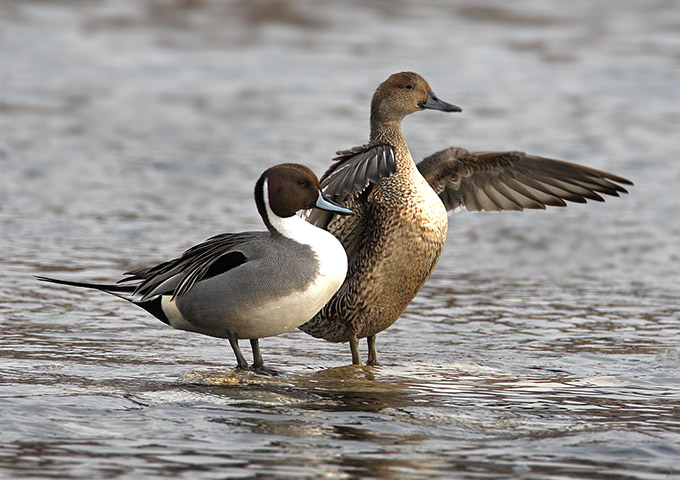
The Northern Pintail (Anas acuta) is one of the most widespread waterfowl, making it one of the most numbers waterfowl worldwide due to their distribution  However, their populations in North America have been declining. The Central Valley of California supports over 50% of the Northern Pintail continental wintering population. However, with very little wetlands present, this poses a threat for habitat. In the 1960s, the population was estimated to be over close to 7 million and currently is down to less than 4 million pintails. Although common and widespread, there is a decrease in numbers because of the poor habitat quality in the United States. A main issue for Northern Pintails having recruitment is the way they lay nests. If their nest fails, they will not renest, this is problematic since they will lose their nest to grain harvest. Suggested management is to reduce hunting disturbance on the female Northern Pintails, and conservation efforts should try to conserve stopover sites during migration as well as conserve large and permanent ponds for the pintail.

Case Study: Pink Footed Goose


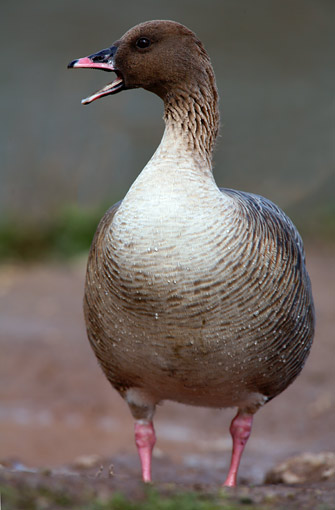
The Pink-footed Goose (Anser brachyrhynchus) has had increasing conflict with humans and their agriculture. With an estimated population size of about 70,000 individuals, the geese tend to remain on wintering grounds feeding on cereal grains such as wheat. This has become an optimal food source since it is easily accessible and is reliable to be around in winter whereas their previous food preferences Poa (Poa sp.) is not as easy to obtain. This new availability of wheat has caused increase in range, a population growth and has created crop damage. But even with this population growth  it is not attributed to having better nesting success, it is just the geese are being able to survive longer. With the increased agricultural use of the land, the geese are now having to find new areas to go to, and therefore are losing previously suitable habitat.

Pink-footed Goose
Since the conflict, the AEWA has planned on making this the first official conservation case to see if they can solve the issue. This is because the pink-footed goose is having issues with human economic activities, mainly agricultural lands, yet does not have very large population sizes. Since the population is under 125,000 this agreement believes is suitable enough for a population, they are taking special care of the Pink-footed Goose when it comes to the agricultural conflict. For this species, the African-Eurasian Waterbird Agreeement has four main goals, to maintain sustainable Pink-footed Goose populations, decrease agricultural conflicts, avoid degradation of the tundra and lastly to allow recreational use around the geese, but not allow it to create conflict with the goose.

Case Study: Redhead

The Redhead (Aythya americana) is a duck that stays North America (thus the name for the specific epithet, americana). These birds typically breed in the Prairie Pothole Region, an area that is being severely degradated through agricultural practices  thus putting nesting areas at risk for the Redhead, causing population declines. Although still common, they have had sharp declines in the population size.
An interesting topic about the Redhead is that it parasitizes on it's "similar" looking Canvasback. The interesting thing about this, is the Redhead is smaller than the Canvasback, but yet the Redhead is frequently successful. Redheads perchance parasitize because they may be young and inexperienced or they already have an established nest and just put their eggs in other nests to increase their reproductive success. Also, redheads have more options in nesting than typical ducks (they can either lay eggs or not lay eggs):

  1. Not lay eggs
  2. Lay just parasitic eggs
  3. Lay eggs in their own nest
  4. Combine parasitism and laying eggs in their own nest
This can increase their reproductive success since they have more options. Other reasons why the redhead may do this is: weather conditions (poor conditions, less likely to spend energy on a nest), young females put a lot of effort into nesting successful, they lose the ability to survive over winter and also there is a certain weight threshold which may make the females switch strategies. Heavier females frequently occupy nests more than the lighter females.  They do not only parasitize on the Canvasback but will often lay eggs in the nests of Northern Pintails, Cinnamon Teal, Mallards and Ruddy Ducks. 

Case Study: Lesser Snow Goose

Since the 1960s, the Lesser Snow Goose (Chen caerulescens caerulescens) population has been exponentially increasing. This may be attributed to the abundant food that is present in the wintering grounds. New foods available since the 1960 include high energy grains that fatten up the snow geese. Since it is so large, however, it is difficult to obtain an accurate estimate of the population size, but it is believed to be about 6 million in the 1990s, making it the largest population of all waterfowl in North America. With such a large population, one would generally believe the population is doing well. However, it has been determined that the body size of snow geese and survival rate of goslings has decreased because of the severe habitat degradation caused by the overabundance of snow geese. With such a large population, they frequently overgraze the grass.
Management Actions
In 1999, the United States Fish and Wildlife Service (USFWS) attempted to find a way to control the population more directly. Previously, there was hunting regulations because of the Migratory Bird Act, but with such large population numbers, the regulations were lessened  This was done by the Light Geese Conservation Order. This order created more open seasons just to hunt these geese and bag limits no longer exist which will hopefully reduce the population numbers, for thus far, it hasn't made a dent in the populations. In fact, the populations continue to grow as they previously did even with these new limited restrictions. New management strategies must be implemented before these geese ruin more Arctic lands, which in turn affect other wildlife as well as there own population. Some suggestions have been to encourage hunters to hunt the geese and to maintain the harvest protocols of no bag limits and extended seasons as well as going to nesting sites and controlling the egg populations.

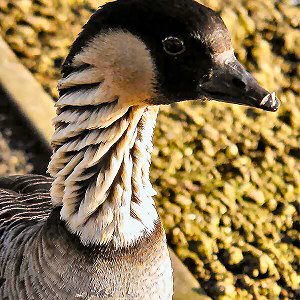
Case Study: Nene

Established in 1972 the Endangered Species Act (ESA) has been trying to save species from extinction. An example we have learned is about the Aleutian Cackling Goose, the Layasan Teal, and the Nene.
Here we will discuss the Nene. In 1967 (even before the ESA was established) the Nene was considered as endangered. The once very endangered Nene, has now been listed as "vulnerable" rather than near extinction. This, in itself, means a lot for conservation biology, a success story. Although it is not totally out of the woods for extinction, it is one step closer to being a self-sustaining population once again. But what were the initial causes of decline for this population?

  1. Exploitation of the early Europeans
  2. Habitat degradation due to leisure activities or agriculture 
  3. Predators introduced (rats, mongoose)
In sum, humans have caused this near extinction of the Nene. This story, however, has shown that reintroduction of a species can work. With a population at one time being 17 birds in the wild, the population has now reached about 2000 birds in the wild, attributed to reintroduction. A recovery plan was created for the Nene in 1949 and is now the longest conservation effort in the world. Birds were captive bred at the Wildfowl Wetlands Trust in Europe and brought to Hawaii to be released. Some issues with captive breeding, however, it is very expensive and most times fail. Reasons that it could potentially fail with the Nene is: the Nene has lost cultural aspects of its life, such as foraging and social skills were inept. This could cause issues with ensuring a long-term sustaining population. Is it work it to invest all this time? We discussed this in class and had a slight debate about what we believed to be feasible and if we thought it was right to spend all of this time and money trying to conserve one species even if it didn't seem like it was going to work. But having a population that was only at 17 at one point and now has reached 2000 means that there is hope yet and with new innovations we can find ways to save these populations more effectively. Refer to the Conservation topic in Element 2 to see more of the discussions we had.
There is still a long way to go with this bird, it is not out of danger yet. Paying attention to this topic will be important to help us determine how effective reintroduction could be for species. 

Long Point Waterfowl

Mission: "advance the conservation and management of waterfowl and other wetland associated organisms and their habitats."
Established in the late 1980s and based in Canada the main focus of Long Point Waterfowl is to study the Great Lakes. Their main focuses is research, conservation and education. They conduct a lot of research and host undergraduate, graduate and doctorate students that publish papers through a research program.  They strive to increase public awareness and create feasible management objectives for waterfowl.
Things they do:

  • Youth hunter education courses
  • Duck festivles 
  • Having undergraduate, graduate and PhD students conducting research
  • Research types include:
    • Monitoring waterfowl populations
    • Assessing habitats (wetlands)
    • Creating management implications from research
There is no way to gain "membership" however, there are ways to support this organization through donations.


California Waterfowl Association


Mission "The California Waterfowl Association is a statewide nonprofit organization whose principal objectives are to conserve California’s waterfowl, wetlands and hunting heritage."

Originally established in 1945 to help regulate hunting policies in California, California Waterfowl Association still holds true to having a foundation primarily in the hunting side of waterfowl conservation.
The main goals now are:

  1. Have sufficient and widely dispersed waterfowl in California 
  2. Protect recreational activities of hunting
  3. Sustain hunting in the future by gathering new hunters and sustaining the old hunters
  4. Educate the public about the benefits of hunting
  5. Increase membership to further conserve California waterfowl
  6. Ensure that this organization is going to be around long term 
  7. Improve quality of volunteers to help accomplish all previous goals!
As can be seen, a strong emphasis is placed on the importance of hunting and maintaining that tradition. They believe that is and was one of the most important factors in conserving the waterfowl and the wetlands they inhabit. As said previously, only about 5% of the wetlands in California remain while still millions of waterfowl pass through. It is important to have a conservation non-profit organization in our area due to this huge loss of suitable habitat. 
Some things that the California Waterfowl Association has accomplished include: 
  • 970 projects
  • Improving over 400,000 acres of habitat
  • Through the Wood Duck Program, over 600,000 ducklings have hatched
  • Through education approximately 250,000 children and adults have been further educated on hunting and conservation.


Wednesday, May 15, 2013

Delta Waterfowl

Mission "Delta provides knowledge, leaders and science-based solutions that efficiently conserve waterfowl and secure the future for waterfowl hunting."
Vision "To secure the future of waterfowl and waterfowl hunting.
Delta Waterfowl is an organization whose main focus is research of waterfowl. They attempt to conduct high quality research while communicating the results effectively  With their research, they try to influence public policy.  They attempt to train students to become better scientist as well as promote hunting as an important part of waterfowl management. 
This organization was created by the founder of General Mills. He felt that it was important to sustain waterfowl populations and understand how to sustain them through a science-based approach. With the creation of a science-based approach to creating sustainable populations, he decided to do this through creating scientists. Thus far, there has been over 300 students who have graduated and written over 700 published papers to contribute to our knowledge about waterfowl. Bell believed that conservationist should make management plans based upon scientific evidence and that is what wildlife managers now do. We use adaptive management strategies to ensure that the populations of waterfowl will continue to remain sustainable for future generations. They are also advocates for hunters because that is where people tend to connect with nature most and where money is contributed to conserving wildlife, they claim that next to habitat loss, this could be detrimental for waterfowl, since that is how we obtain money to conserve waterfowl.
Some projects that they are currently working on is mainly based on the pothole region. Some projects include encouraging the public to adopt a pothole (basically public pays some money so we conserve and save acres of potholes), predator control (many breeding birds roost on the potholes and predator control needs to be done), hen houses (used to protect the ducks from predation) along with a few other projects. They also host a range of ways for people to get involved in hunting, creating educational videos via the internet and training sessions in person. 
Membership costs about $50.00 and gets a magazine and a yearly subscription to support the waterfowl conservation (mainly in the Prairie Pothole Region).

Ducks Unlimited


Mission Statement "Ducks unlimited conserves, restores, and manages wetlands and associated habitats for North America's waterfowl. These habitats also benefit other wildlife and people."
Vision "The vision of Ducks Unlimited is wetlands sufficient to fill the skies with waterfowl today, tomorrow and forever." 

Becoming a member of this organization can be done with a $35.00 donation. Money donated to this area goes to conservation of waterfowl. Some accomplishments that Ducks Unlimited have done thus far: 
Where Your Dollar Goes
  1. Influenced over 100 million acres of land.
  2. Conserved 13 million acres of waterfowl habitat
  3. Banding of waterfowl for population assessments
  4. As well as education of public
In California alone, there has been 1300 projects performed by Ducks Unlimited and this has conserved more than 700,000 acres of waterfowl habitat. California is important to conserve, according to Ducks Unlimited, because there is no where else in the world where so many waterfowl (coming from the Pacific Flyway) must survive on such limited amount of land. Approximately 95% of all wetlands have been depleted, and millions of waterfowl still pass through this region every year.

The top areas of conservation concern to Ducks Unlimited are: 
  1. Prairie Pothole Region
  2. Western Boreal Forest- Canada
  3. Mississippi Alluvial Valley
  4. Central Valley/ Coastal California 
  5. Gulf Coastal Prairie
They want to make a note that they try to conserve in every state, but they make sure to take care of the important and prime habitat in areas such as the ones above. This is to ensure the most waterfowl are protected with feasibility taken into account. 

Thursday, May 2, 2013

Farm Bill and CRP

The Farm Bill was created in 1933 to figure out the economic hardships of agriculture. This also included unfair practices of exporting and soil erosion and what these negative impacts had on agriculture in the USA. Within the Farm Bill there are a variety of programs, including CRP (Conservation Reserve Program). Every 5 - 7 years the farm bill expires and needs to be revamped and put back into the governments hands to ensure the newest practices are being used.
The Conservation Reserve Program was initiated officially in 1985 by the Farm Bill. Unofficially it was established in the 1930s and 40s with the beginning of the Farm Bill. This program helps to create sustainable practices for farmers. When land is not in use for agriculture, CRP pays farmers to have natural ecosystems on their land, including water, soils, native grasses and wildlife. It was estimated that USA loses about 2 billion tons of soil annually, so preserving these lands is crucial. In the Prairie Pothole Region  however, there has been a recent decrease in the people renewing their agreement with the CRP. This is due to the increase in demand of corn subsidies to create ethanol biofuel (CRP conversion article). Approximately 9.7 million acres have been taken out of the Conservation Reserve Program since 2007, which could potentially be detrimental to the habitat waterfowl use in the region.