Thursday, May 16, 2013

Case Study: Red-breasted Goose

Previously I talked about this in the Breeding Biology section of the blog; however, more needs to be discussed about the conservation issues the Red-breasted Goose (Branta ruficollis) faces. This waterfowl is one of the most endangered in the Eurasian continent. These geese breed with avian predators which will attack foxes that will potentially predate the nests of these geese. With the presence of the hawks, owls and falcons, the Red-breasted Goose is able to have a higher nesting success. There is a cost to this; however, at times, the adults will be eaten and once the goslings hatch, the Red-breasted Goose must ensure that the goslings make it to water safely before the raptors can hunt them. The population of these geese crashed in the 1950s, potentially due to an indirect effect of DDT. A common conservation case of the Peregrine Falcon (Falco peregrinus) and its steep decline due to the influence of DDT and its egg shell thinning effects, the Red-breasted Goose was also affected because the Peregrine Falcon were no longer able to protect the nests of the Red-breasted Goose. The geese sleep on ponds, but these ponds are often occupied by fisherman which cause disturbance for rest. Other threats include rodenticides, lack of hunter knowledge, man-made infrastructure deaths and land changes from cereal crops (preference) to vegetables and vineyards.
Suggestions for management include educating hunters, creating feeding grounds, higher management on fishing around the geese to reduce disturbance as well as to continue the ban on the poisons that killed many falcons.

Case Study: Canvasback

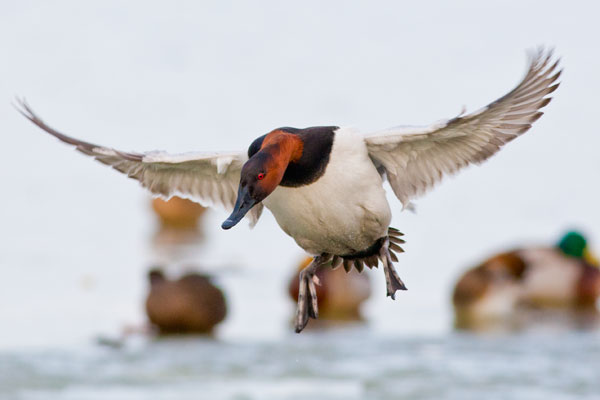
Historically, the Canvasback (Aythya valisinera) declined due to hunting, habitat degradation and poor water quality. On the east coast of North America, it was one of the most hunted birds and was claimed to be one of the tastiest. Currently, their populations are doing well with about 700,000 individuals from a census done in 2012. The reason that this bird could be recovering may be attributed to various reasons such as the ban of lead shots, the Wetlands Reserve Program, MBTA and Lacey Act. For the future, there are still issues that await the Canvasback management. For instance, there is still high wetland loss which means less habitat. These animals are diving ducks and rely on these wetlands more than some birds because they are diving ducks and the aquatic vegetation that the wetlands provide. There was a diet shift in the Canvasback due to poor water quality from fish and invertebrates to the aquatic vegetation.

Case Study: Northern Pintail

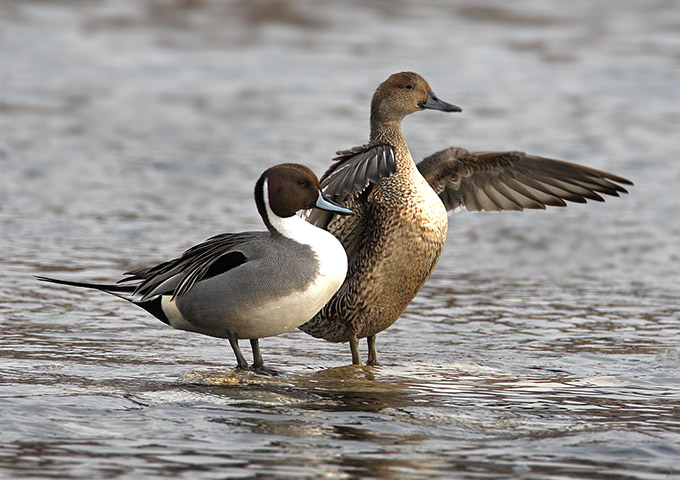
The Northern Pintail (Anas acuta) is one of the most widespread waterfowl, making it one of the most numbers waterfowl worldwide due to their distribution  However, their populations in North America have been declining. The Central Valley of California supports over 50% of the Northern Pintail continental wintering population. However, with very little wetlands present, this poses a threat for habitat. In the 1960s, the population was estimated to be over close to 7 million and currently is down to less than 4 million pintails. Although common and widespread, there is a decrease in numbers because of the poor habitat quality in the United States. A main issue for Northern Pintails having recruitment is the way they lay nests. If their nest fails, they will not renest, this is problematic since they will lose their nest to grain harvest. Suggested management is to reduce hunting disturbance on the female Northern Pintails, and conservation efforts should try to conserve stopover sites during migration as well as conserve large and permanent ponds for the pintail.

Case Study: Pink Footed Goose


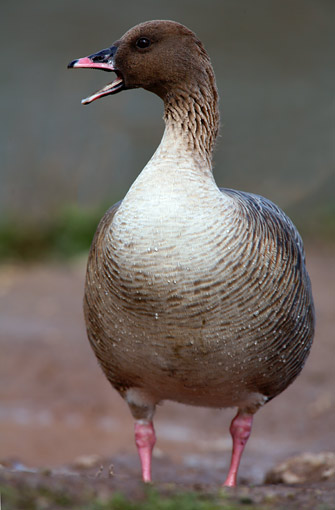
The Pink-footed Goose (Anser brachyrhynchus) has had increasing conflict with humans and their agriculture. With an estimated population size of about 70,000 individuals, the geese tend to remain on wintering grounds feeding on cereal grains such as wheat. This has become an optimal food source since it is easily accessible and is reliable to be around in winter whereas their previous food preferences Poa (Poa sp.) is not as easy to obtain. This new availability of wheat has caused increase in range, a population growth and has created crop damage. But even with this population growth  it is not attributed to having better nesting success, it is just the geese are being able to survive longer. With the increased agricultural use of the land, the geese are now having to find new areas to go to, and therefore are losing previously suitable habitat.

Pink-footed Goose
Since the conflict, the AEWA has planned on making this the first official conservation case to see if they can solve the issue. This is because the pink-footed goose is having issues with human economic activities, mainly agricultural lands, yet does not have very large population sizes. Since the population is under 125,000 this agreement believes is suitable enough for a population, they are taking special care of the Pink-footed Goose when it comes to the agricultural conflict. For this species, the African-Eurasian Waterbird Agreeement has four main goals, to maintain sustainable Pink-footed Goose populations, decrease agricultural conflicts, avoid degradation of the tundra and lastly to allow recreational use around the geese, but not allow it to create conflict with the goose.

Case Study: Redhead

The Redhead (Aythya americana) is a duck that stays North America (thus the name for the specific epithet, americana). These birds typically breed in the Prairie Pothole Region, an area that is being severely degradated through agricultural practices  thus putting nesting areas at risk for the Redhead, causing population declines. Although still common, they have had sharp declines in the population size.
An interesting topic about the Redhead is that it parasitizes on it's "similar" looking Canvasback. The interesting thing about this, is the Redhead is smaller than the Canvasback, but yet the Redhead is frequently successful. Redheads perchance parasitize because they may be young and inexperienced or they already have an established nest and just put their eggs in other nests to increase their reproductive success. Also, redheads have more options in nesting than typical ducks (they can either lay eggs or not lay eggs):

  1. Not lay eggs
  2. Lay just parasitic eggs
  3. Lay eggs in their own nest
  4. Combine parasitism and laying eggs in their own nest
This can increase their reproductive success since they have more options. Other reasons why the redhead may do this is: weather conditions (poor conditions, less likely to spend energy on a nest), young females put a lot of effort into nesting successful, they lose the ability to survive over winter and also there is a certain weight threshold which may make the females switch strategies. Heavier females frequently occupy nests more than the lighter females.  They do not only parasitize on the Canvasback but will often lay eggs in the nests of Northern Pintails, Cinnamon Teal, Mallards and Ruddy Ducks. 

Case Study: Lesser Snow Goose

Since the 1960s, the Lesser Snow Goose (Chen caerulescens caerulescens) population has been exponentially increasing. This may be attributed to the abundant food that is present in the wintering grounds. New foods available since the 1960 include high energy grains that fatten up the snow geese. Since it is so large, however, it is difficult to obtain an accurate estimate of the population size, but it is believed to be about 6 million in the 1990s, making it the largest population of all waterfowl in North America. With such a large population, one would generally believe the population is doing well. However, it has been determined that the body size of snow geese and survival rate of goslings has decreased because of the severe habitat degradation caused by the overabundance of snow geese. With such a large population, they frequently overgraze the grass.
Management Actions
In 1999, the United States Fish and Wildlife Service (USFWS) attempted to find a way to control the population more directly. Previously, there was hunting regulations because of the Migratory Bird Act, but with such large population numbers, the regulations were lessened  This was done by the Light Geese Conservation Order. This order created more open seasons just to hunt these geese and bag limits no longer exist which will hopefully reduce the population numbers, for thus far, it hasn't made a dent in the populations. In fact, the populations continue to grow as they previously did even with these new limited restrictions. New management strategies must be implemented before these geese ruin more Arctic lands, which in turn affect other wildlife as well as there own population. Some suggestions have been to encourage hunters to hunt the geese and to maintain the harvest protocols of no bag limits and extended seasons as well as going to nesting sites and controlling the egg populations.

Case Study: Nene

Established in 1972 the Endangered Species Act (ESA) has been trying to save species from extinction. An example we have learned is about the Aleutian Cackling Goose, the Layasan Teal, and the Nene.
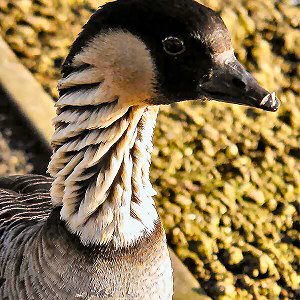
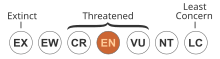
Here we will discuss the Nene. In 1967 (even before the ESA was established) the Nene was considered as endangered. The once very endangered Nene, has now been listed as "vulnerable" rather than near extinction. This, in itself, means a lot for conservation biology, a success story. Although it is not totally out of the woods for extinction, it is one step closer to being a self-sustaining population once again. But what were the initial causes of decline for this population?

  1. Exploitation of the early Europeans
  2. Habitat degradation due to leisure activities or agriculture 
  3. Predators introduced (rats, mongoose)
In sum, humans have caused this near extinction of the Nene. This story, however, has shown that reintroduction of a species can work. With a population at one time being 17 birds in the wild, the population has now reached about 2000 birds in the wild, attributed to reintroduction. A recovery plan was created for the Nene in 1949 and is now the longest conservation effort in the world. Birds were captive bred at the Wildfowl Wetlands Trust in Europe and brought to Hawaii to be released. Some issues with captive breeding, however, it is very expensive and most times fail. Reasons that it could potentially fail with the Nene is: the Nene has lost cultural aspects of its life, such as foraging and social skills were inept. This could cause issues with ensuring a long-term sustaining population. Is it work it to invest all this time? We discussed this in class and had a slight debate about what we believed to be feasible and if we thought it was right to spend all of this time and money trying to conserve one species even if it didn't seem like it was going to work. But having a population that was only at 17 at one point and now has reached 2000 means that there is hope yet and with new innovations we can find ways to save these populations more effectively. Refer to the Conservation topic in Element 2 to see more of the discussions we had.
There is still a long way to go with this bird, it is not out of danger yet. Paying attention to this topic will be important to help us determine how effective reintroduction could be for species.